
Replication across Azure regions - Linux
The following diagram illustrates the sample configuration for setting up replication across regions:
Figure: Sample configuration for setting up replication across regions
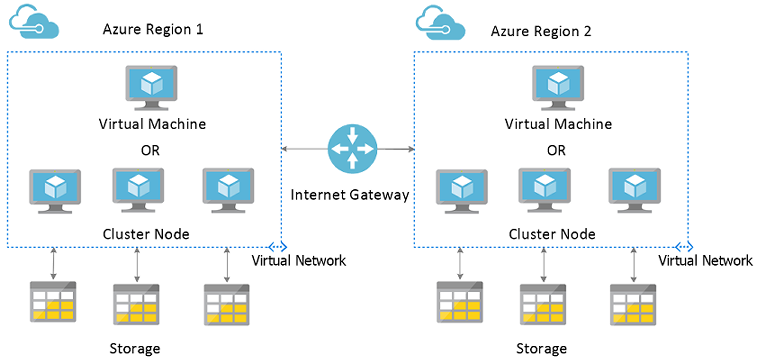
Setting up replication across regions
Perform the following steps to set up replication across region
-
Enable the ports that are used for inbound and outbound communication.
For a list of required ports and services, refer to the InfoScale Replication Administrator's Guide - Linux.
-
Using Azure portal, create a resource group (RG) in both the regions.
-
Create a VNet in each region and specify a non-overlapping IP address space for each VNet.
-
Create a subnet and a gateway subnet under the VNets created in both the regions.
-
Create a virtual network gateway in both the regions.
-
Establish a connection in between the two virtual network gateways.
-
Create virtual machines in the subnets and provision storage.
-
Install the appropriate InfoScale product.
-
Create VxVM disk groups, VxVM volumes, Storage Replicator Log (SRL), Replicated Volume Group (RVG), and RLinks.
For details, refer to the InfoScale Storage Foundation Cluster File System High Availability Administrator's Guide - Linux
Note: In Azure environment, by default, in addition to the storage disks that you have attached, every virtual machine that is provisioned contains a temporary resource disk, that serves as an ephemeral storage. Do not use the temporary resource as a data disk (VxVM disk) to store persistent data. The disk may change after a machine is redeployed or is restarted, and the data will be lost. For more information about how Azure uses a temporary disk, see Microsoft documentation. For details about how to identify a temporary resource disk: SeeAbout identifying a temporary resource disk - Linux.
-
Flush the iptables on both the virtual machines.
# iptable -F
-
Set up replication using the private IP address or the virtual IP address.
For details on setting up replication, refer to the InfoScale Replication Administrator's Guide - Linux.
-
Verify the replication status.
# vradmin -g dg_name repstatus rvg_name
Ensure that the replication status shows:
Replication status: replicating (connected)
Related information